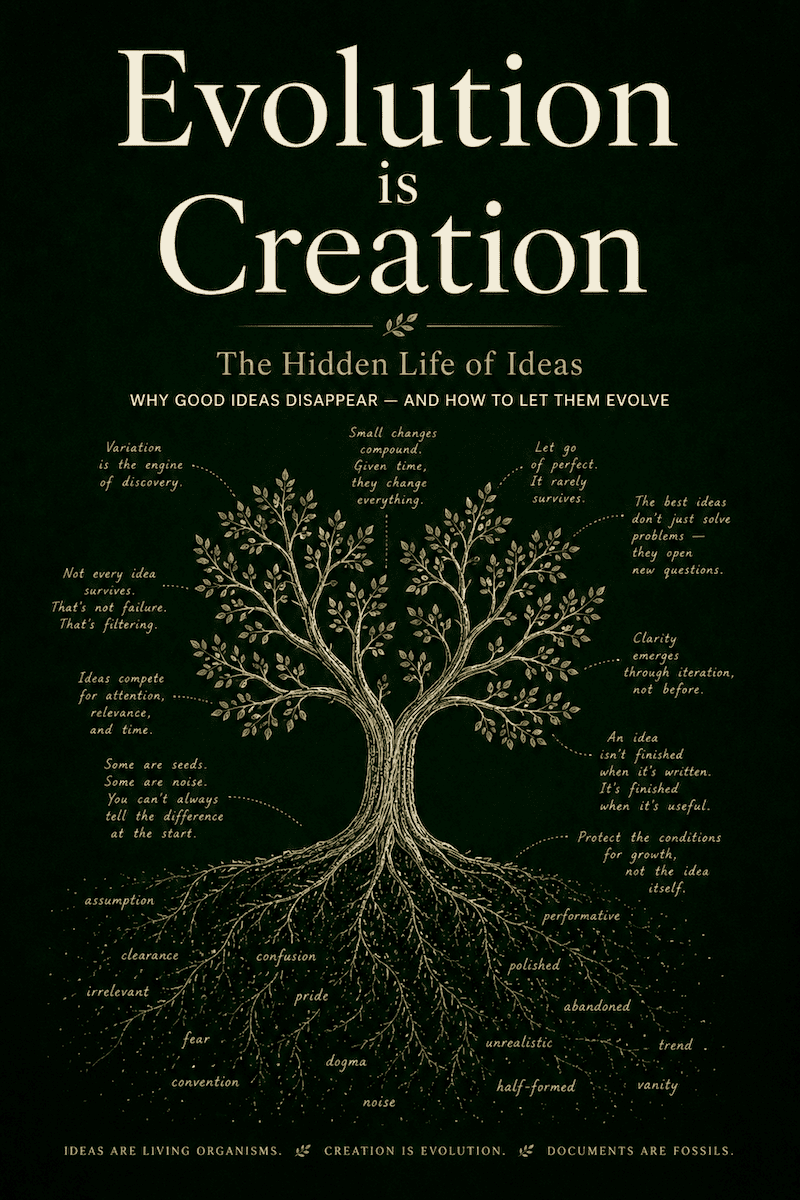
Evolution is Creation
The Hidden Life of Ideas
Ideas don't appear fully formed.
They evolve.
Evolution is Creation explores the hidden process behind every idea — from the first random thought to the final creation. It outlines the methodology behind local-first knowledge management, dynamic version branching, and why the document format of the last thirty years is holding your thinking back.
The Core Concepts
This short book is not a tutorial on software features. It is a manifesto exploring how linear documents constrain natural thought, and how structural evolution allows writing to mirror the human brain.
Why Linear Documents Restrict Thinking
Standard document files (like `.docx` or linear `.md`) assume writing progresses sequentially from top to bottom. But thought is non-linear, recursive, and multi-directional. Linear tools force early consensus, causing creators to lose alternative draft paths.
Idea → Draft → Branch → Creation
Ideas are sparks, drafts are attempts, branches are evolutionary forks, and creations are final selections. Discover how structuring your writing as a visual matrix allows you to trace the heritage of your concepts back to their roots.
Continuous Evolution over Single Passes
Great works are rarely written in a single sequence. They are re-drafted, refined, and compared side-by-side. Branching histories maintain all alternative paths so you can merge elements of different iterations without destructive copy-pasting.
The Philosophy behind MeshWrite
Why we designed a visual node system rather than a standard left-side file tree. Explore the core design decisions behind local-first SQLite architectures, offline device persistence, and why sync should be an optional, self-hosted commodity.
Book Preview
Excerpt from Introduction: The Flat Canvas
For three decades, digital writing has been defined by the paradigm of the blank sheet of paper. We open a word processor, and we are confronted with a vertical linear white page. We type from left to right, line by line, scroll down, and save.
This model works exceptionally well for the final, polished deliverable. It is the structure of the invoice, the contract, the printed report.
But it fails catastrophically for the process of creation itself.
Before an article is finished, it is a messy bundle of contradictory
arguments. Before a codebase is compiled, it exists as a series of
design trade-offs. Before a novel is compiled, it branches through
dozens of alternate character actions. When we write in a linear
document, we are forced to delete our alternate drafts, or leave
behind a trail of confusing folders like draft_v1_backup.txt and final_draft_v2_edit.txt.
We deserve a workspace that matches the shape of thought. A workspace where ideas can branch, compete, and evolve.
Ready to experience non-linear writing?
Bring the methodology to life. Download MeshWrite Desktop to build your local visual branch matrix.