
How Your Ideas Die
Part I · The Crime Scene of Creation
Core Question: Why do so many great ideas vanish before they ever take shape, rather than being proven wrong?
This chapter answers just one question: How exactly does the death of an idea happen?
1.1 Anatomy of a Death
Let us follow an idea through the final hours of its life.
It is 2:00 AM. You have just finished reading an article, and a sudden spark ignites—two previously unrelated concepts click together in your mind. You feel an electric surge of clarity. You grab your phone, type a single sentence, put it down, and fall asleep.
The sentence is: Creation is evolutionary—not by design, but by selection.
The next morning, you open your memo app and stare at those words.
You know they meant something vital just hours ago. You remember the excitement. But the context that anchored that thrill—the article you were reading, the mental image, the precise cognitive bridge between those two concepts—is completely gone.
You stare at the sentence for a full minute.
Then you close the app and check your email.
This idea wasn't rejected. No one told you it was foolish. It simply lacked the environment to keep growing, and so it quietly slipped away.
1.2 The Three Mechanisms of Expiration
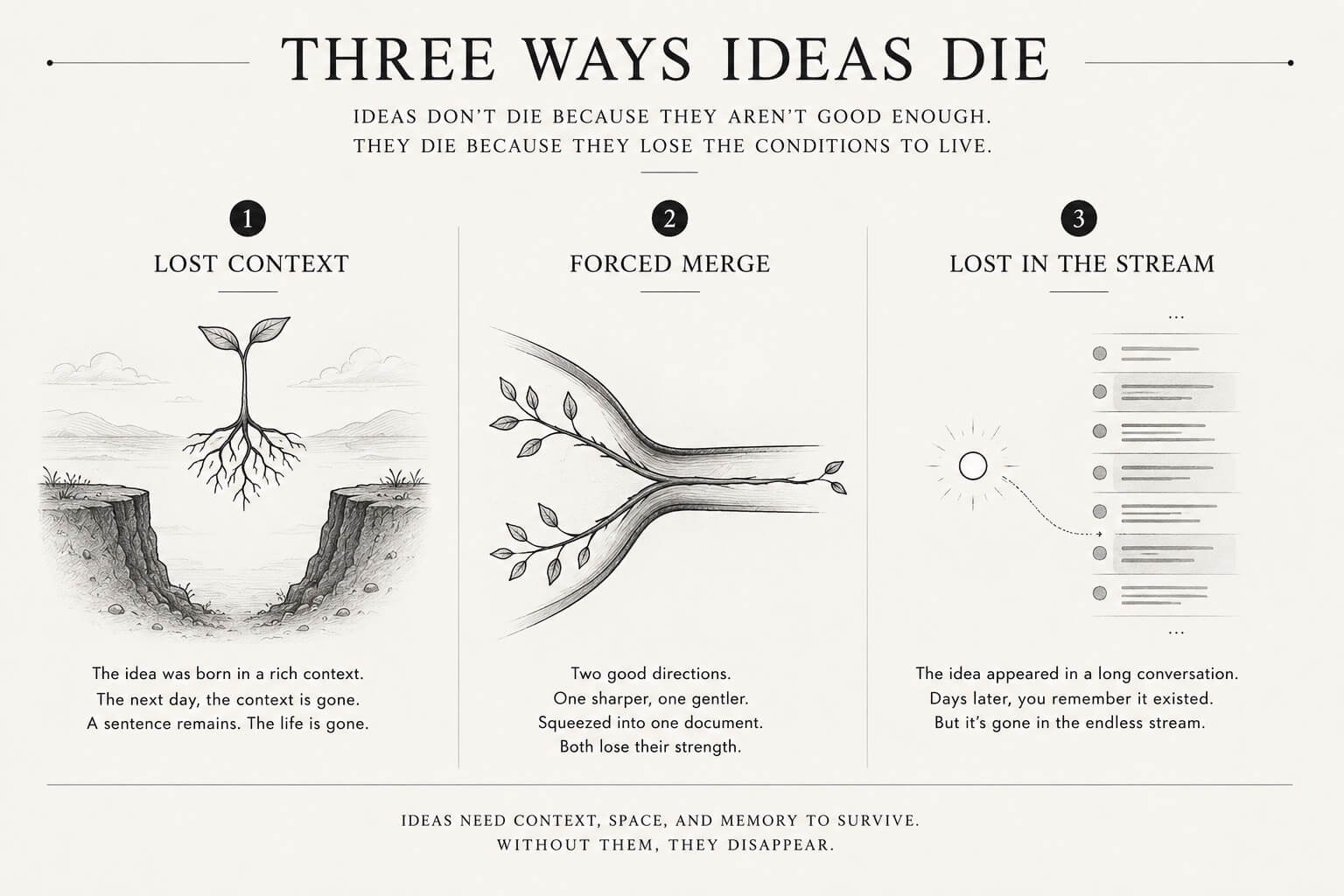
The First Trap: Loss of Context.
Your late-night memo captured only the dry conclusion, leaving behind the entire ecosystem that birthed it—the mood, the associative links, the immediate problem you were solving. The next day, you are left with a sterile sentence rather than a living thought.
The Second Trap: Forced Consolidation.
You have two distinct paths: one sharp and provocative, the other soft and reassuring. In an attempt to tidy up, you squeeze them into a single draft. You edit, compromise, and rewrite until both paths lose their edge. The idea wasn't rejected; it was squeezed to death in a polite compromise.
The Third Trap: Sinking into the Chat Stream.
You spend forty minutes in a brilliant back-and-forth session with an AI. At one point, a spectacular, original perspective flashes by. Three days later, you remember that moment of clarity, but you have no way to find it. The chat history preserved every word, but it completely lost the trail of where the breakthrough actually happened.
These three mechanisms share a single root cause: The idea was denied the environment it needed to survive and grow.
It died before it ever had a chance to get good.
Epigram
Ideas die not because they are weak, but because they are denied the conditions to live.
We are conditioned to think that creative struggle is a personal deficit—a lack of talent, grit, or inspiration. But more often, it is a structural failure. We are trying to nurture fragile thoughts using tools and workflows designed to store static documents.
Desktops cluttered with "final" files, lost chat threads, half-baked tangents, and old projects we suddenly remember six months too late—these are not personal flaws. They are symptoms of the exact same system error.
This book is about building a system where those ideas actually survive.
Tonight's Action
Recall an idea you lost. Don't try to revive it. Simply ask yourself: Which of the three traps killed it? Was it a loss of context, a forced consolidation, or did it sink into a chat stream? Write down one sentence identifying the trap.