
Owning Infinite Branches for the First Time
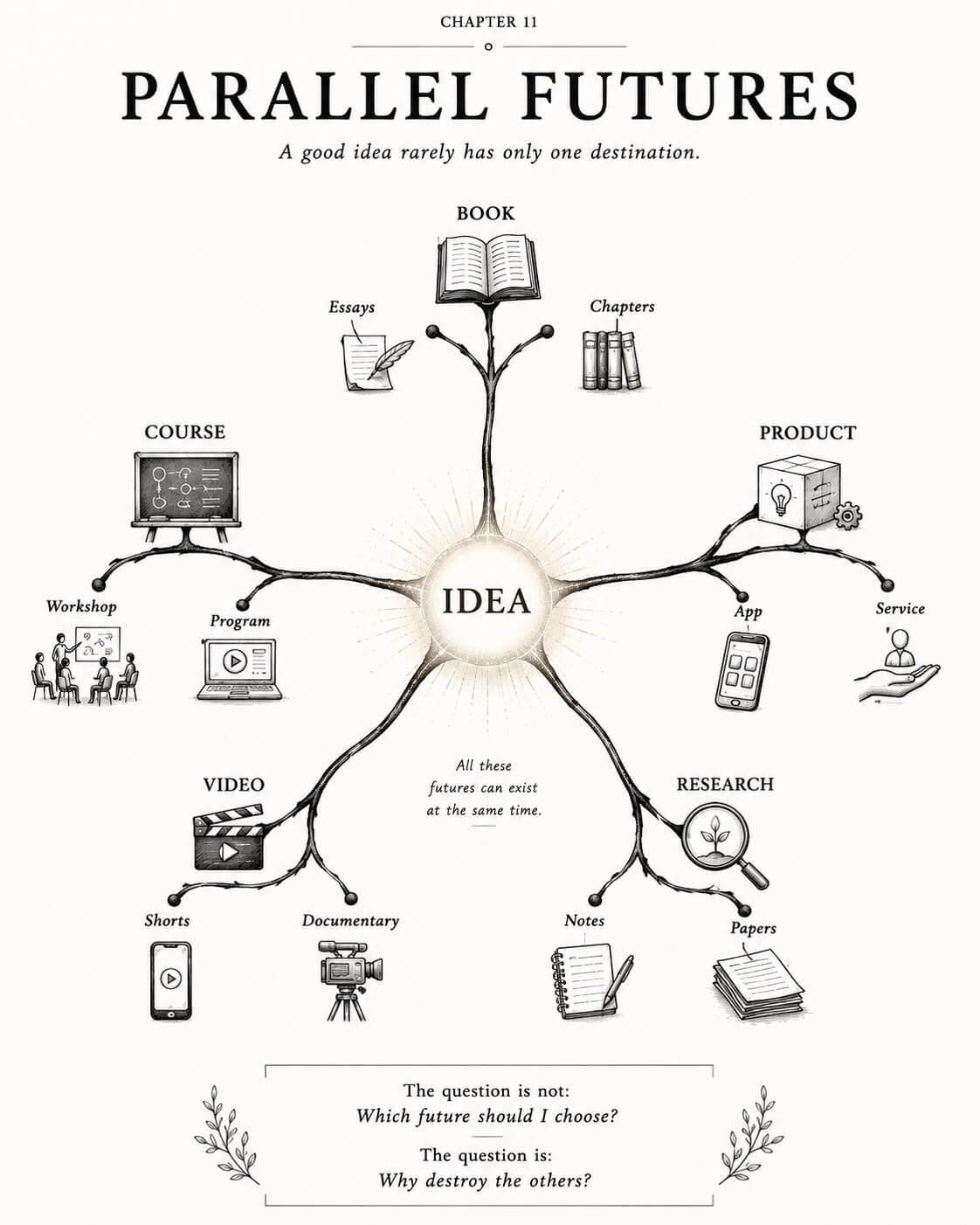
Part IV · Creation in the AI Era
Core Question: When the cost of branching falls to zero, how does the basic unit of creation change?
This chapter answers just one question: What happens when branching costs nothing?
11.1 The Pain of the Single Path
A novelist once remarked that the most painful moment in writing isn't being stuck; it is getting to Chapter Three and realizing you chose the wrong narrative perspective in Chapter One.
To fix Chapter One means rewriting everything you have done since. Most writers don't do it. They suppress the doubt, ignore the alternative perspective, and tell themselves: It's fine, I'll just make this work.
This isn't laziness. It is a rational response to high physical costs.
We have always lived under strict resource constraints. Testing three different structures for an essay, or mapping out five commercial strategies for a product, used to take days of manual labor. The high cost of exploring branches forced us to commit to a single path far too early.
The alternative possibilities were simply left to die.
11.2 Exploring Parallel Futures
AI changes this fundamentally.
A single thought node can now split instantly into multiple variations: a playful version, a formal version, an executive summary, a video script, or a contrarian take. The novelist's dilemma can be tested in minutes. You can explore those three narrative perspectives over an afternoon.
For the first time, creators can generate variation at the scale of nature.
This shifts the basic unit of creation.
The traditional unit was the Document: a single file that you modified step-by-step until it was done. The future unit is the Branch: a core thought that sprouts parallel directions, allowing you to compare, discard, and merge their best elements.
A project is no longer a single flat text; it is an active family tree of potential futures.
Epigram
The true promise of AI is not the ability to write a single draft faster, but the freedom to explore parallel futures simultaneously.
But infinite branching can easily turn into infinite noise.
The Galápagos finches evolved into distinct, functional species because the islands imposed clear environmental boundaries—food availability, predators, and weather. The environment forced selection.
The more branches you generate, the more you need explicit selection criteria:
-
Who is the specific reader?
-
What is the core constraint?
-
Which variation actually reveals something true?
Branching without selection pressure is just clutter.
Tonight's Action
Take a current project. Before you generate any new variations, define three distinct dimensions of difference—such as audience, tone, structure, or risk level. Force every new version to diverge clearly along at least one of these lines. These constraints are the selection pressures that keep your branches functional.