The Future Workspace of Creation
Part V · The Evolution Workspace
Core Question: If we take the biography of thoughts seriously, how must our creative tools change?
This chapter answers just one question: What does the future of creative tools look like?
16.1 Moving Beyond the Static Page
Every popular creative tool today is built to answer a single, static question: What does the current document look like?
Word, Google Docs, Notion, and even our AI chat interfaces are obsessed with the present state. You open a file, and you see what is there right now. Yesterday's draft, the paragraph you cut last week, the parallel direction you tested and abandoned—these elements are completely invisible.
But creation does not happen only in the present.
Creation lives in the journey—the drafts, the branches, the rejected options, the 2:00 AM memos, and the insights that flashed by in your chat history. These layers are the true biography of the work.
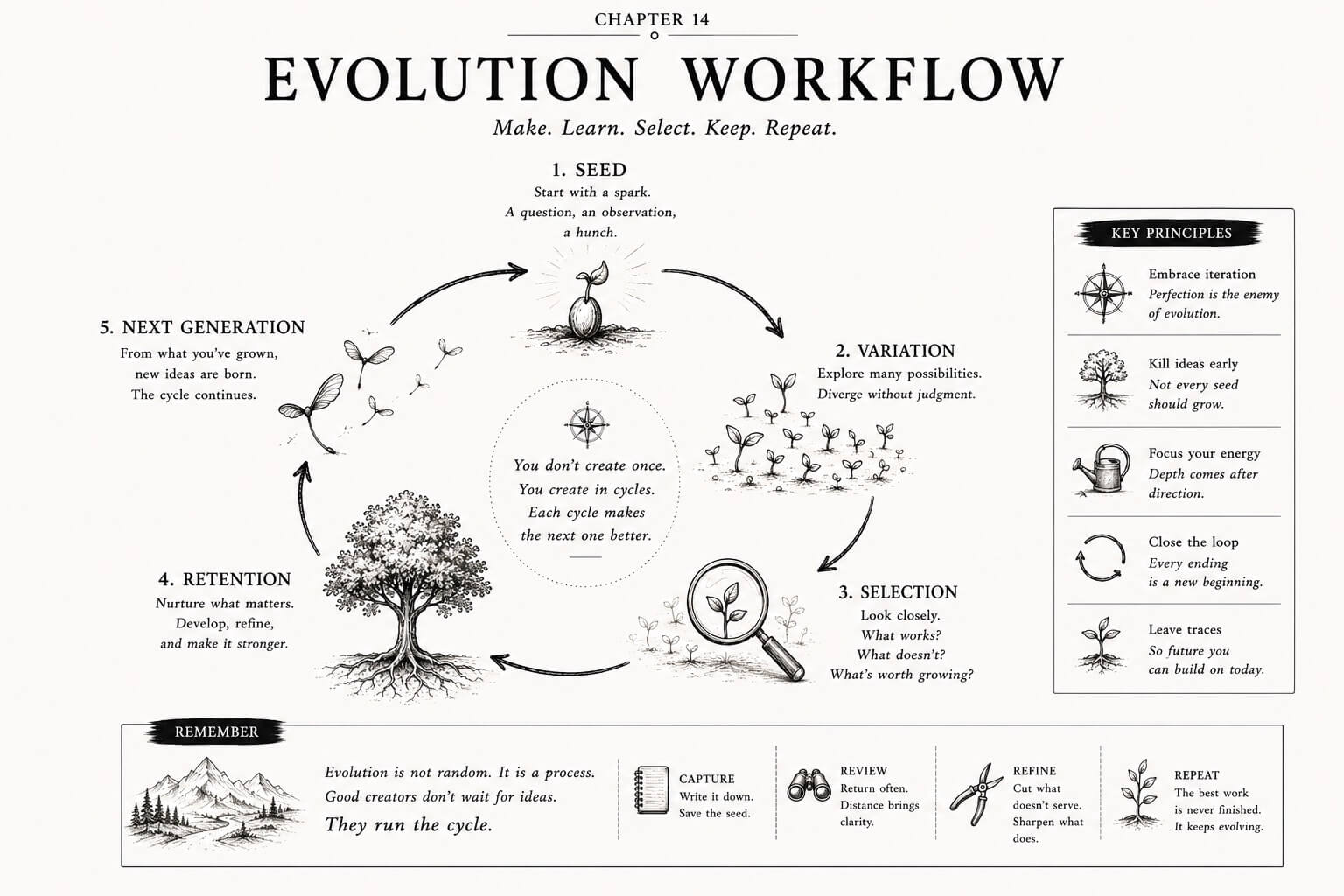
If thoughts are indeed living things, our tools cannot remain static digital paper. A document editor manages flat text; an evolutionary workspace preserves the process of how that text came to life.
16.2 A Living Map for Mind
Imagine opening a workspace that isn't a blank white page, but a living map.
On the left are your seeds: late-night sparks, captured quotes, and raw questions. In the center are your active branches: your analytical draft, your personal narrative branch, your contrarian experiment. On the right is your thought biography: showing exactly where this version diverged, what elements it absorbed from abandoned drafts, and why you made key structural decisions.
You are no longer sorting through flat folders for the "latest" draft. You can see exactly which evolutionary path is thriving.
An evolutionary workspace must possess five core capabilities:
-
Seed Capture—insulating fragile early thoughts so they don't dissolve.
-
Branching—allowing parallel futures to exist simultaneously without overwriting progress.
-
Visual Curation—making comparison and selection intuitive.
-
Genetic Harvesting—simplifying the process of salvaging valuable fragments from discarded drafts.
-
Lineage Tracking—revealing the entire biography of how the work evolved.
This is not a software feature list. It is the necessary infrastructure for a new way of creating.
16.3 But Will Systems Kill the Magic?
This is a very reasonable concern. Whenever we introduce systems to creativity, we worry: Will this turn art into a spreadsheet? Will it make writing feel like project management? Will it replace raw inspiration with mechanical steps?
But the goal of a good system is never to control the output; it is to protect the input.
An evolutionary workspace doesn't tell you what your idea should become. It simply ensures your young thoughts don't die before they have a chance to grow. It doesn't automate the art; it preserves your paths so you don't get lost in the noise. It doesn't turn creation into a machine; it builds an ecosystem where your ideas can live.
Epigram
The creative tools of the future will not just store your documents; they will document how your thoughts grow.
When these workspaces become standard, "Final_Version.docx" will look like a relic from a primitive era. We will stop asking: Where is the latest file? We will ask: Which evolutionary path has the most life?
Tonight's Action
Evaluate your current primary creative tool against the five core requirements: Can it capture seeds with context? Can you explore parallel branches easily? Can you compare drafts side by side? Can you easily salvage fragments from abandoned drafts? Can you see the biography of your changes? For every "No," design a simple manual habit to bridge the gap. Tools may be limited, but your awareness doesn't have to be.