After Answers Become Surplus
Part IV · Creation in the AI Era
Core Question: When AI can generate infinite text instantly, what is it that creators actually lack?
This chapter answers just one question: When answers are infinite, what is the creator's real job?
10.1 From Production to Curation
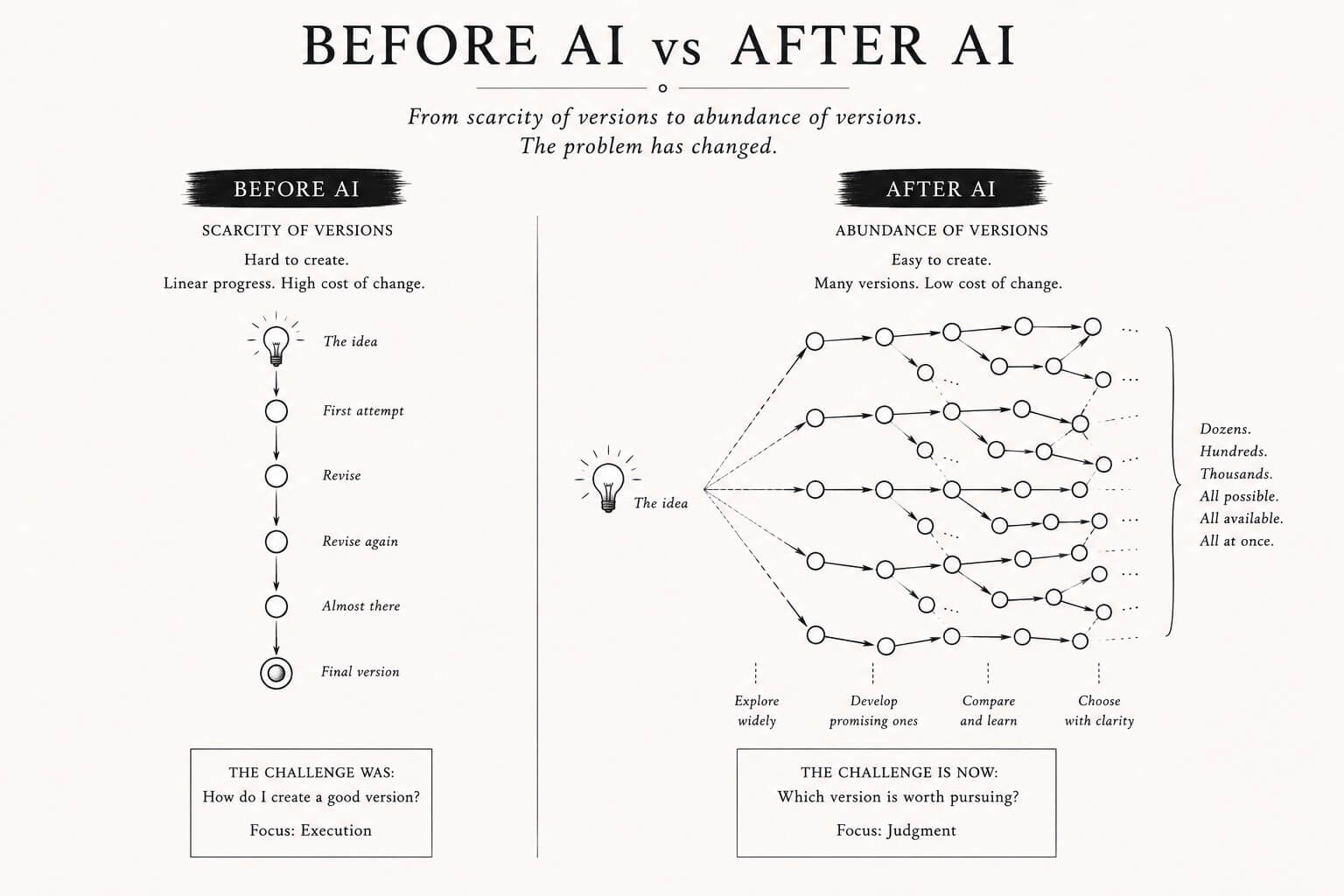
For most of human history, the primary bottleneck in creation was the physical act of production.
Drafting a manuscript was slow. Painting a canvas took time. Building a prototype required physical materials. This high cost of production forced us to choose a single direction early and stick to it, simply because we didn't have the resources to explore alternatives.
Generative AI has eliminated this bottleneck. It can produce drafts, code, and designs in seconds.
But when production becomes effortless, the value of raw output drops to zero.
Anyone can generate fifty variations of an essay opening in under a minute. The critical question is no longer "How do I write this?" but:
-
Which of these drafts actually has a soul?
-
Which one is merely fluent, and which one actually opens up a new perspective?
-
Which rejected option contains a hidden seed worth rescuing?
10.2 The Creator as Director
In the AI era, the creator's role shifts from performer to director.
An actor delivers the lines. A director decides which take has the right emotional truth, how the scenes hang together, and where the story needs to go.
As a creator, your job is to design the search space, establish the constraints, encourage useful mutations, compare the results, and salvage the brilliant fragments. You are no longer just asking "Is this good?" You are asking "Where is this path leading?"
This is a different kind of creative skill: it is the art of guiding evolution.
10.3 But Can't AI Make the Decisions Too?
You might wonder: if AI is smart enough to generate the drafts, why can't it just choose the best one? Why can't we just ask it to rate them and pick the winner?
AI can certainly help analyze your work. It can find logical flaws, spot repetition, suggest counter-arguments, and simulate different reader reactions.
But it cannot choose what is worth caring about.
Creative selection isn't a technical optimization problem. It is an expression of taste, values, risk-tolerance, and timing.
A draft can be perfectly logical without being brave.
A paragraph can be incredibly smooth without being honest.
A version can look exactly like a viral hit while completely missing what you actually wanted to say.
AI can participate in variation, but it cannot take responsibility for selection.
Epigram
When answers are a surplus, the core of creativity shifts from generation to selection. AI makes mutation cheap, but it makes curation vital.
AI will not automatically make everyone more creative. It simply makes variation incredibly cheap. Whether those variations evolve into something meaningful still depends entirely on how the human mind guides the process.
This is why Darwin's journey is so relevant today. He did not suffer from a lack of inspiration; he was overwhelmed by observations. His genius lay in his ability to curate, test, and find the single, beautiful path through the noise.
That is your job now. And it is a job AI cannot do for you.
Tonight's Action
The next time you use AI for a project, do not simply ask it to "rewrite" or "improve" your text. Try this "director-level" exercise instead:
-
Ask the AI: "Looking back at our conversation, which of the options I rejected actually contained the most interesting or unconventional angle, and why?"
-
Take that rejected path and apply two deliberate selection pressures by asking:
-
Pressure A (The Skeptic): "If a highly critical reader who disagrees with my premise reviews this angle, what is the single most devastating flaw they would point out?"
-
Pressure B (The Novice): "If a complete beginner reads this, what is the one concept that will immediately spark their curiosity?"
-
-
Compare these responses, and decide which elements are strong enough to inherit into your next draft.