Why Pixar Believes in Scrap Drafts
Part II · The Hidden Laws of Creation
Core Question: Why do great creative works require a mountain of abandoned versions?
This chapter answers just one question: Why do great creative works require a mountain of abandoned versions?
7.1 The Boardroom of Storyboards
The walls of the meeting room are completely covered in storyboards. Frame by frame, a movie is pinned up, stripped down to hundreds of illustrated moments.
The director stands at the front, pitching the emotional arc of a scene. The people sitting around the table are masters of storytelling themselves, but they aren't there to applaud.
They are there to point out where the scene feels unearned, where the pacing drags, where a character's motivation falters, and where the audience will lose interest. This isn't a typical critique; it is a session of Pixar's "Braintrust"—a system where candid peers help the creator see the blind spots in their own work.
Almost every masterpiece Pixar has released went through this process. Openings were completely thrown out, protagonists were fundamentally redefined, and major subplots vanished late in production. In early versions of Coco, the protagonist was a very different character. In early drafts of Inside Out, the character "Bing Bong" didn't even exist.
This isn't because the creators weren't brilliant at the start.
It is because a story's life cannot be fully calculated in advance. A story must be built, visualized, tested, torn apart, and put back together. The work itself must be allowed to show you where it lacks life.
7.2 Scrap Drafts are Search Spaces
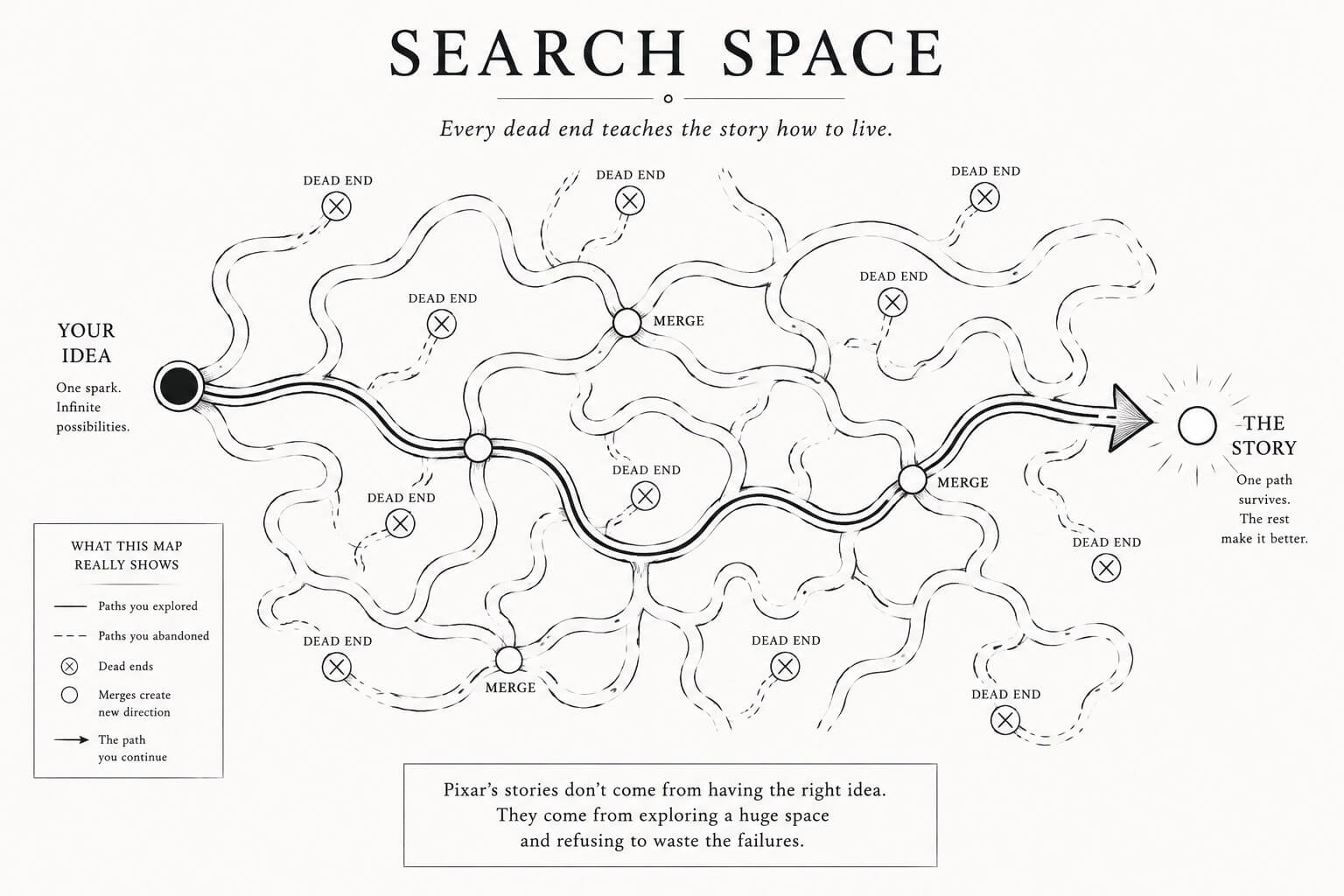
Scrap drafts are not waste. They are your search space.
Every abandoned version answers a vital question: Why did this path fail? What part of it is still worth keeping? What deeper problem did it reveal?
If a character is cut, their absence might make the central conflict much sharper. If an opening is thrown out, it usually reveals that the audience wants immediate stakes rather than backstory. If a subplot is removed, it allows the main theme to breathe for the first time.
If we only look at the final script, creation looks like magic. But when you look at the mountain of discarded drafts, you realize the final work is simply the version that survived a rigorous process of elimination.
A great story is rarely the first idea you had; it is the idea that survived enough honest mistakes.
Epigram
Discarded drafts are not failures; they are the search space. A great work is rarely written; it is found through elimination.
This realization should be incredibly freeing for any creator.
You don't need to get the first version right. You just need a system that can tolerate a lot of bad versions—and a habit of analyzing those versions rather than simply deleting them.
Pixar's success isn't just about hiring geniuses. It is about building a system where scrap drafts are useful.
You don't need a corporate Braintrust to do this. You only need to change one basic habit: stop deleting your bad drafts. Start annotating them.
Tonight's Action
Find a discarded draft or an abandoned project. Don't rewrite it, and don't delete it. Add two quick notes at the top: Why did this version fail? and What single piece of it is still worth keeping? If you find something worth keeping, that fragment is the genetic material for your next attempt.