
Evolution Doesn't Look for Correct Answers
Part II · The Hidden Laws of Creation
Core Question: How does nature build immense complexity without a master blueprint?
This chapter answers just one question: How does nature build immense complexity without a master blueprint?
6.1 The Designer Without a Blueprint
On the Galápagos Islands, there are thirteen distinct species of finches.
They all share a single common ancestor. But as they spread across different islands with different food sources and competitors, their beaks began to diverge. Some grew long and thin, perfect for probing cactus flowers; others became short and stout, designed to crack heavy seeds; some remained moderate, doing a little of everything but specializing in nothing.
Not a single beak was "designed" on a drawing board.
Nature's method is beautifully simple: generate variations, expose them to the environment, and let the environment select which traits survive to be passed down. It requires no master plan, no foresight, and no advance knowledge of the final outcome.
This process relies on three core actions:
-
Variation—generating diverse possibilities.
-
Selection—allowing the environment to determine which variations are viable.
-
Retention—passing the successful traits forward to serve as the baseline for the next generation.
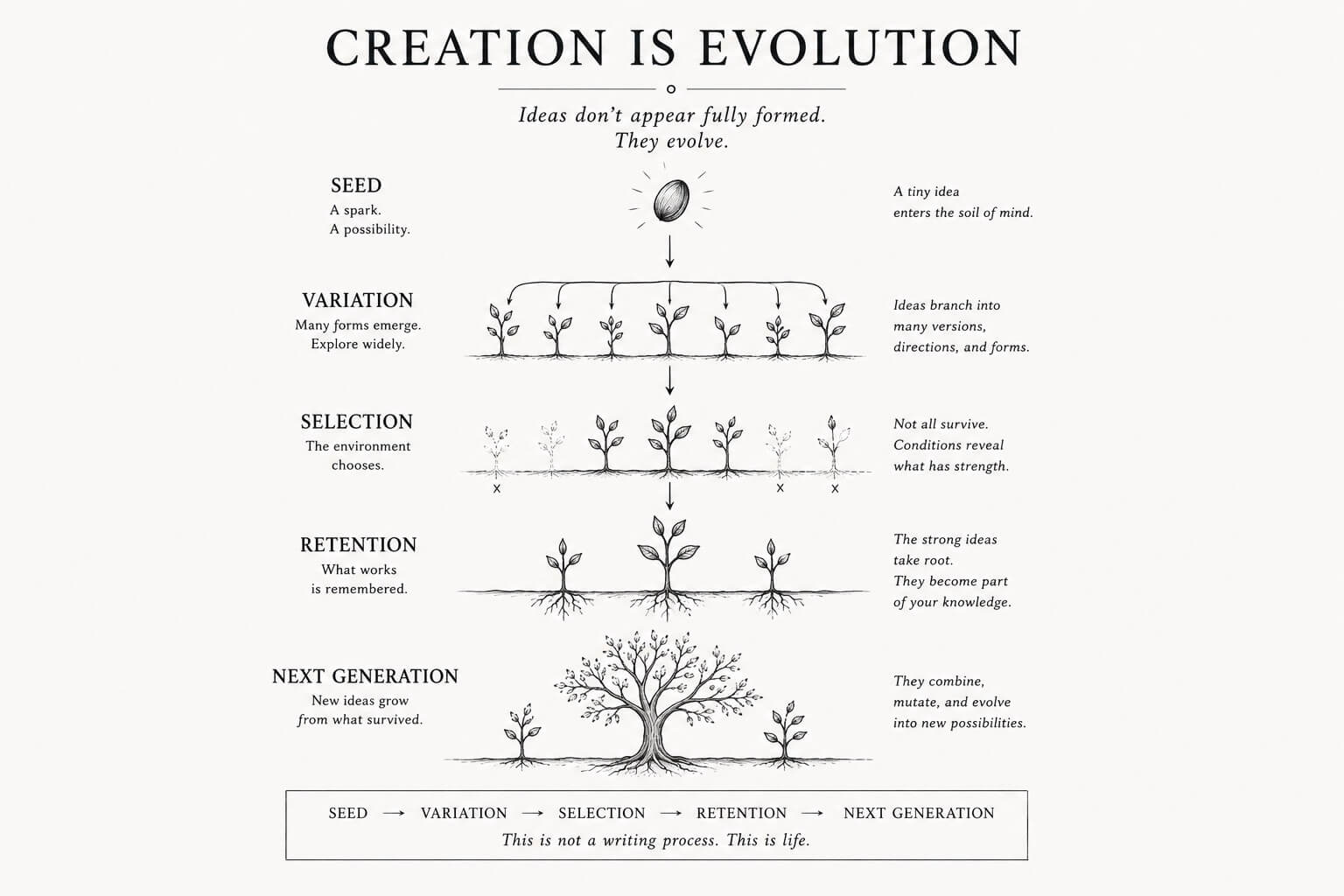
Without variation, there is no progress.
Without selection, you have only noise.
Without retention, every step forward is lost.
6.2 The Illusion of the Perfect Draft
The reason evolution is so successful is that it doesn't need to know the answer before it begins.
This is completely counter-intuitive to how we are taught to create.
We are told that good writing requires a perfect outline before we type a single word. We are told that product design requires perfect market research before development starts. We assume that breakthrough theories occur to genius minds in a sudden, fully-formed flash of insight.
But creative challenges rarely have a single, static "correct answer."
A great headline depends entirely on the audience. A great product depends on the immediate user context. A great theory is validated only by what it explains and what new questions it opens up.
The "correct answer" is not a pre-determined destination you know before you set out. It is the path you recognize only when you look back at the ground you have covered.
Nature doesn't search for correct answers. It explores possibilities.
Creation operates exactly the same way.
Epigram
Creation = Variation + Selection + Retention. This formula is far more accurate than "Inspiration + Effort."
The Evolution of a Thought
-
Generate Variation: Spin out multiple directions for a single idea.
-
Test Environment: Expose those variations to real readers, different platforms, or harsh critiques.
-
Apply Selection: Notice which versions generate real resonance or clarity.
-
Retain Strengths: Salvage valuable elements even from the drafts that failed.
Result: The retained strengths become the foundation for the next round of variation.
This explains why great work requires multiple drafts.
Drafts are not mistakes; they are mutations.
Comparison is not procrastination; it is selection.
Saving your process is not a hobby; it is genetic inheritance.
Your scrap drafts are not proof of failure. They are the paths you explored—the essential ancestors of the version you haven't written yet.
Tonight's Action
Take a draft you are unhappy with. Don't rewrite it. Instead, write two simple lines next to it: Why this draft failed and What valuable element it still contains. Salvage at least one thing—a phrase, an example, a transition, or a question. This is how you pass down genetic material to your next version.