"Final_Version.docx" Will Always Exist
Part I · The Crime Scene of Creation
Core Question: Why does every serious creator end up with a folder full of "final" versions?
This chapter answers just one question: Why does every serious creator end up with a folder full of "final" versions?
3.1 The Comedy on Your Desktop
Take a look at your desktop, or that folder you simply named "Projects."
If you have ever tried to create anything of substance, you will likely find a familiar sequence of files:
Draft_Final.docx
Draft_Final_v2.docx
Draft_Final_Edits.docx
Draft_Final_Real_Final.docx
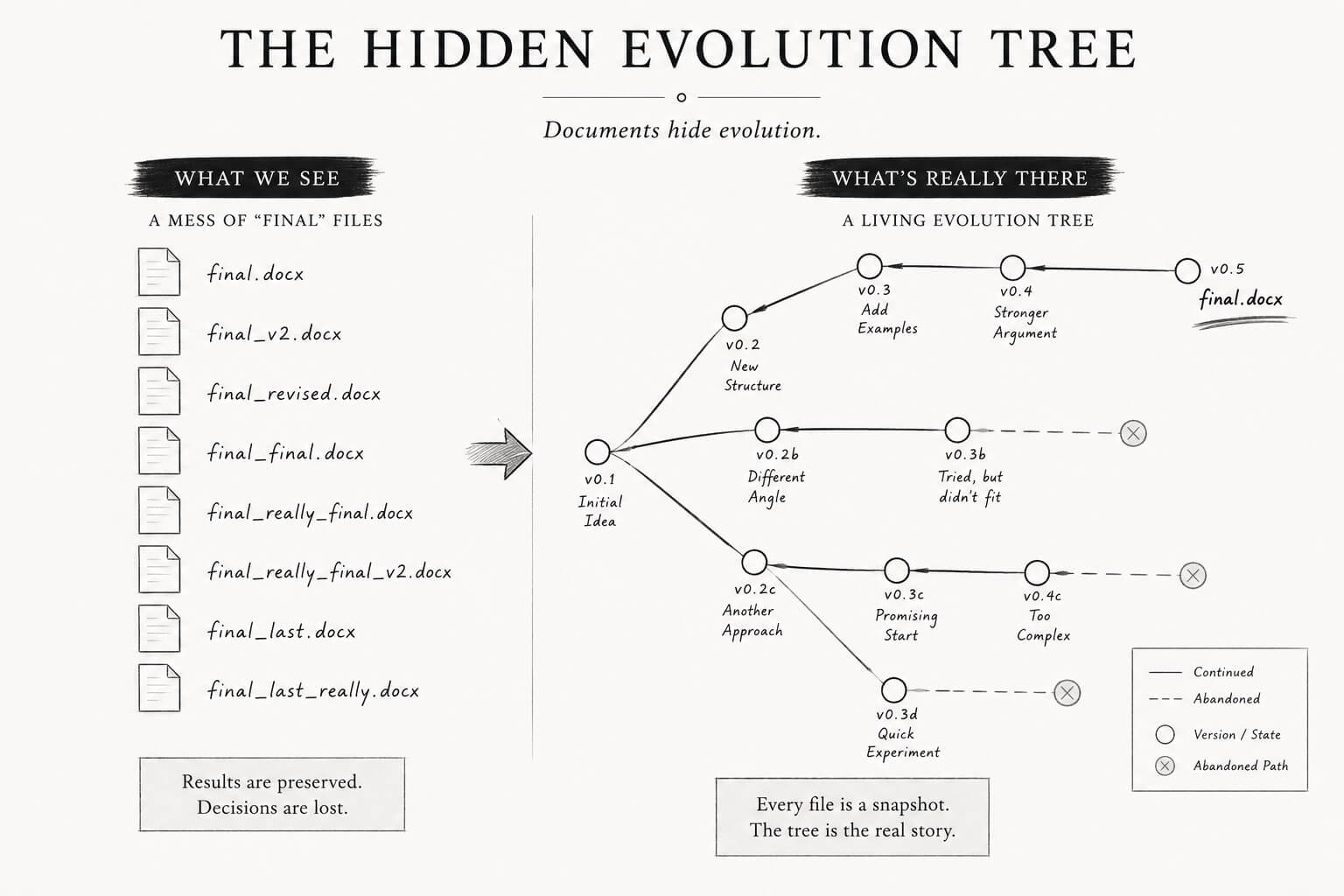
We know there is no such thing as a "final" version, yet we repeatedly name our files this way. Each "Real Final" file is an awkward attempt to fight a truth our current tools refuse to acknowledge: creation is not a straight line.
3.2 Results Survive, Decisions Vanish
This mess of files is actually a failed evolutionary tree. You wanted to preserve your progress while testing new ideas; you wanted to explore a fresh direction without destroying your stable copy; you wanted to go back to an older version but forgot which one actually worked.
Because traditional documents only show their current state, they have no native place to record why a change happened, where a branch diverged, or how two versions relate to each other. So, we try to force that complex evolutionary relationship into the file names.
The real tragedy isn't having ten final drafts on your desktop. The tragedy is that by the time you reach the seventh draft, you have completely forgotten why you made the fourth.
The text survives, but the decisions vanish.
You can still open the file, but you can no longer open the thinking that created it: Why did you cut that specific opening? Why did you alter this structure? Why did you label one draft "For Client" and another "Story Focus"?
These lost decisions are your most valuable creative assets. Yet they are completely discarded by tools designed to output static files. Traditional editors are built to display results, not to capture how those results were reached. They flatten a living process into a flat artifact. The harder you work to explore new possibilities, the more cluttered your workspace becomes—simply because your tools cannot represent your actual thinking.
Epigram
The text survives, but the decisions vanish. Documents are the fossils of creation, not the life.
Note
The issue isn't that documents are useless. Fossils are invaluable records. The mistake is confusing the fossil with the living process.
Tonight's Action
Pick a file you have modified multiple times recently. Don't touch the text. Instead, write down three things in a separate note: one direction you seriously considered but ultimately abandoned; one paragraph you deleted but still miss; and one unresolved question you are currently ignoring in the main text. Give each a clear label. You aren't organizing files; you are recovering your decisions.