Creation is Evolution
Part II · The Hidden Laws of Creation
Core Question: Why can creation be redefined as variation, selection, and retention?
This chapter answers just one question: What happens when we view creation through the lens of evolution?
8.1 The Common Thread of Creative Struggle
Let us return to our opening question: Why do our best ideas so often perish before they become finished works?
Because they are denied the basic conditions of evolution.
The 2:00 AM memo saves the seed but loses the environmental context. The "final" file displays the result but buries the decision-making process. The AI chat generates infinite mutations but lacks a stable framework to select and retain them.
But when we look at Darwin's notebooks or Pixar's storyboard rooms, we see a different approach: creation treated as a continuous loop of variation, testing, and selective retention.
When you look through this lens, your creative frustrations begin to make sense.
You didn't lose an idea; you lost an organism because you didn't preserve its environment.
Your files aren't messy; you are trying to force a branching evolutionary tree into flat folders.
You shouldn't fear discarded drafts; you simply haven't learned how to harvest their genetic material.
You aren't overwhelmed by AI; you are drowning in variations because you haven't built a selection mechanism.
These are not separate problems. They are all symptoms of a single core mistake:
We treat creation as the act of producing a finished object, when creation actually happens in the process of evolution.
8.2 Three Propositions
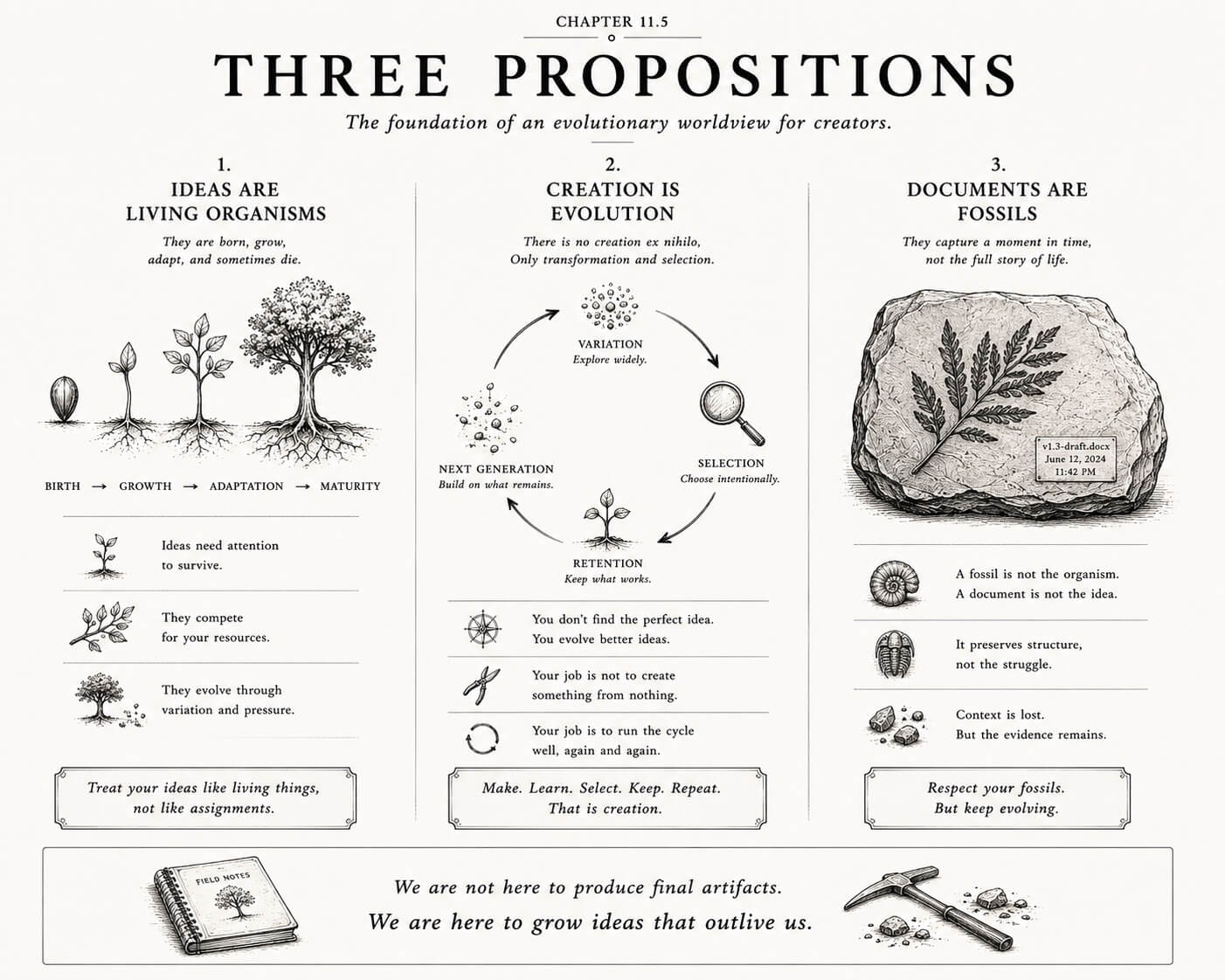
The core theory of this book can be distilled into three simple laws:
The Three Laws of Thought Evolution
Ideas are living organisms. They require an environment, they reproduce, and they mutate.
Creation is evolution. It is not about finding the perfect answer on day one; it is about letting the answer emerge through variation, selection, and retention.
Documents are fossils. A document captures a thought at a single point in time, but it is not the living process itself.
When you accept these three propositions, your entire creative perspective shifts.
Inspiration is no longer a mysterious gift; it is the moment of birth.
A rough draft is no longer a poor product; it is a necessary mutation.
Feedback is no longer a personal critique; it is selection pressure.
A discarded draft is no longer waste; it is a repository of genetic material.
The final version is no longer the entire story; it is simply the fossil that survived.
This is the shift:
You aren't just writing or designing. You are cultivating life.
8.3 But What About Genius?
There is a common objection to this view.
If creation is just evolution, how do we explain true genius? What about Mozart? What about Michelangelo? What about works that seem to appear in the world fully formed, as if by magic? Does this theory reduce all great art to a mechanical process of trial and error?
This objection is important because if it holds true, then evolution is only for ordinary writers, not for true masters.
But the "fully formed" genius is an illusion created because we only see the polished fossils, never the messy evolutionary history.
We marvel at Mozart's compositions, but we forget that he was immersed in an incredibly intense environment of musical training, performance, imitation, and constant revision from early childhood. We admire Michelangelo's David, but we don't see the thousands of anatomical sketches, clay models, and abandoned marble blocks left behind in his studio.
We prefer the myth of sudden inspiration because magic is more entertaining than a long, difficult process of selection.
Genius is not an exception to evolution.
A genius is simply an incredibly high-velocity evolutionary environment. They process inputs faster, mutate concepts more fluidly, apply sharper internal selection, and retain successful traits with absolute precision. What looks like magic is simply evolution happening at extraordinary speed and density.
Genues don't bypass evolution. They drive it to its absolute limits.
Epigram
Great ideas are not created. They survive.
This is not a technical point about tools; it is a fundamental truth about the creative mind.
Once you view creation as evolution, your job changes. You are no longer under pressure to produce a flawless masterpiece on your first attempt. Your job is to protect the seed, encourage variations, set up selection pressures, and salvage the best pieces so your thoughts have room to evolve.
Tonight's Action
Take your most important current project and write down three lines: The Seed (the original spark, in one sentence); The Mutations (the different directions you've explored, even the abandoned ones); and The Genetic Core (the single element from all those versions that absolutely must survive). Keep it raw. Just make the evolutionary history of your project visible for the first time.