
The Forest of Thoughts
Part V · The Evolution Workspace
Core Question: Why is your intellectual capital a living, cross-pollinating forest rather than a set of neat folders?
This chapter answers just one question: Why is your mind a forest rather than a filing cabinet?
14.1 Thoughts Migrate Between Projects
There is a common creative experience that we rarely talk about:
You are working on a specific project when a brilliant analogy suddenly strikes you. But it doesn't fit the current piece. It is too eccentric, too distracting, and it breaks the established tone. So, you delete it.
Six months later, you are working on a completely different project, and you realize you need an analogy—exactly that kind of image, that specific angle. You search your notes, but it is gone. You know it existed, but you can no longer find it.
It vanished.
This quiet loss happens every day. It isn't that a bad idea died; it is that a great idea arrived at the wrong time and was treated as waste because it didn't fit the immediate folder.
An abandoned branch in one project is often the perfect seed for another. A deleted analogy from an essay might make the perfect hook for a product launch; an abandoned course chapter might grow into a standalone article; an unused world-building detail might spark an entire game design.
Folders fool us into believing that ideas belong in neat, isolated compartments. But ideas are living things. They migrate, cross-pollinate, hibernate, and graft onto new trunks.
14.2 The Underground Root Network
Imagine a forest.
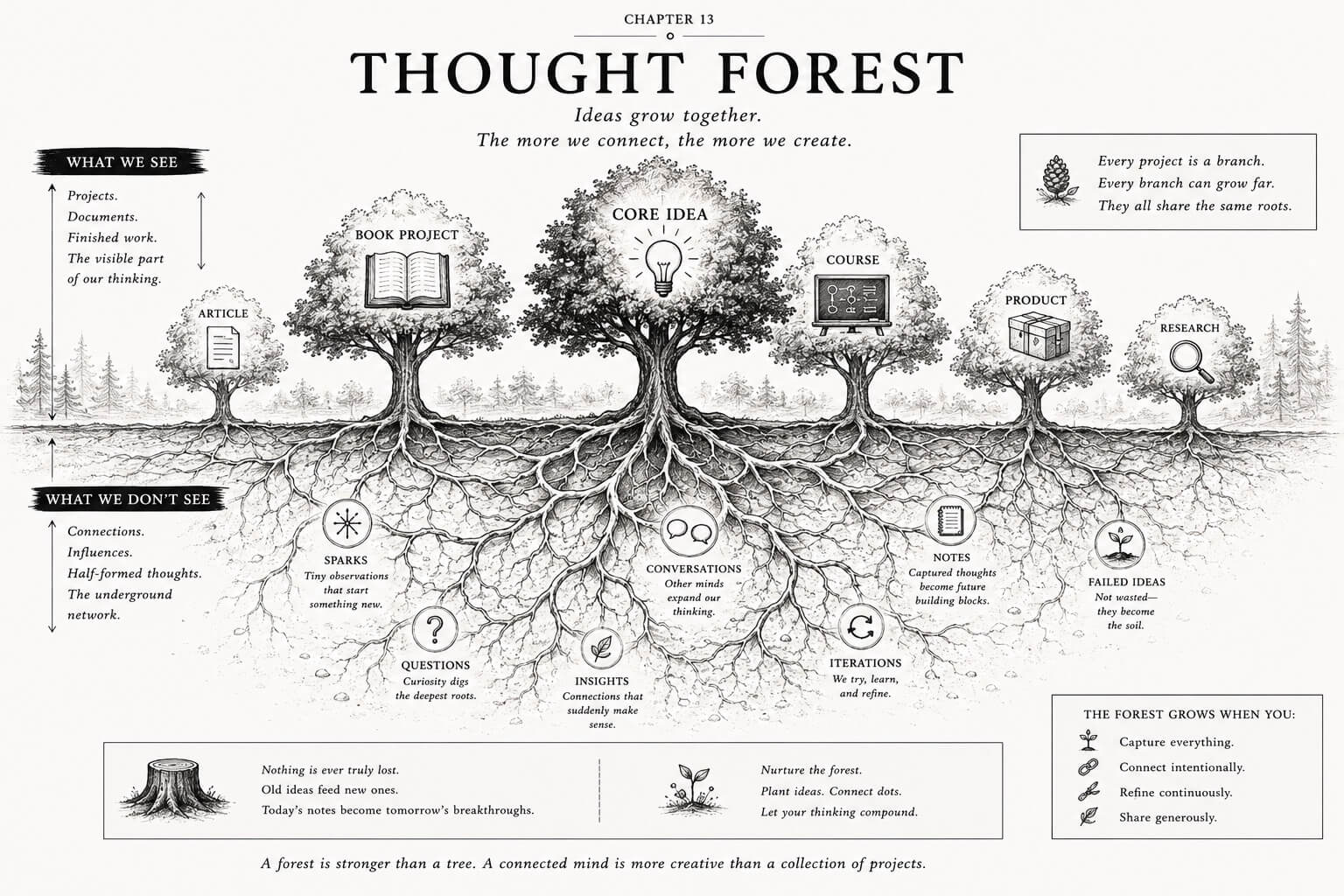
Above ground, you see individual trees: the book you are writing, the product you are designing, the course you abandoned, the fragments in your memo app. They look separate, just like files on your computer.
But underground, they share a single ecosystem.
Their roots are intertwined, sharing nutrients through a deep, organic network. Some older trees have decayed, but their remains form the rich soil that feeds the new growth. An abandoned headline becomes the entry point for a new article; a failed feature becomes the core of a simpler tool; a half-finished story provides the perfect opening for a future speech.
A filing cabinet asks: Where does this file belong?
A forest asks: What does this thought nourish?
As a creator, your real wealth isn't a collection of neat, static files. It is the underground root network connecting your projects. It is about seeing how an old failure provides the nutrients for a new breakthrough, how a recurring theme reveals your deepest values, and how different ideas can cross-pollinate to create something entirely new.
Epigram
You do not own a collection of documents. You cultivate a cross-pollinating, migrating, living forest of thoughts.
Once you see your work this way, your discarded drafts change.
They are no longer trash. They are the organic matter, the seed bank, and the essential ancestors of your future breakthroughs.
That analogy you cut six months ago didn't die. It was simply waiting for the right tree to land on.
Tonight's Action
Go back to three different past projects and find one discarded fragment from each—a sentence, a metaphor, or an abandoned opening. Place them together in a single scratchpad without categorizing them. Ask yourself just one question: What can these fragments nourish today? This is how you begin to build your underground root network.