
Darwin's Twenty Years
Part II · The Hidden Laws of Creation
Core Question: Why was On the Origin of Species a long evolutionary journey rather than a single sudden breakthrough?
This chapter answers just one question: Why was On the Origin of Species an evolutionary journey rather than a single flash of genius?
5.1 The Letter in June 1858
In June 1858, Charles Darwin received an unexpected packet from Alfred Russel Wallace, a young naturalist working in the Malay Archipelago. The packet contained an essay outlining a theory of natural selection almost identical to the one Darwin had been quietly researching for over two decades.
Darwin sat at his desk, his hands shaking.
This was no ordinary correspondence. It was a sudden, jarring reminder that an idea left to sleep in private notebooks and personal letters can easily be bypassed by the world.
Yet Darwin's delay wasn't caused by a lack of ideas. He had the opposite problem: he was overwhelmed by them. He possessed decades of voyage logs, physical specimens, breeding records, extensive correspondence, unpublished drafts, and complex arguments. His challenge was never "finding inspiration." It was figuring out how this massive, chaotic population of observations could evolve into a robust, undeniable theory.
We are taught to view On the Origin of Species as a singular moment of genius. In reality, it was a slow-growing tree.
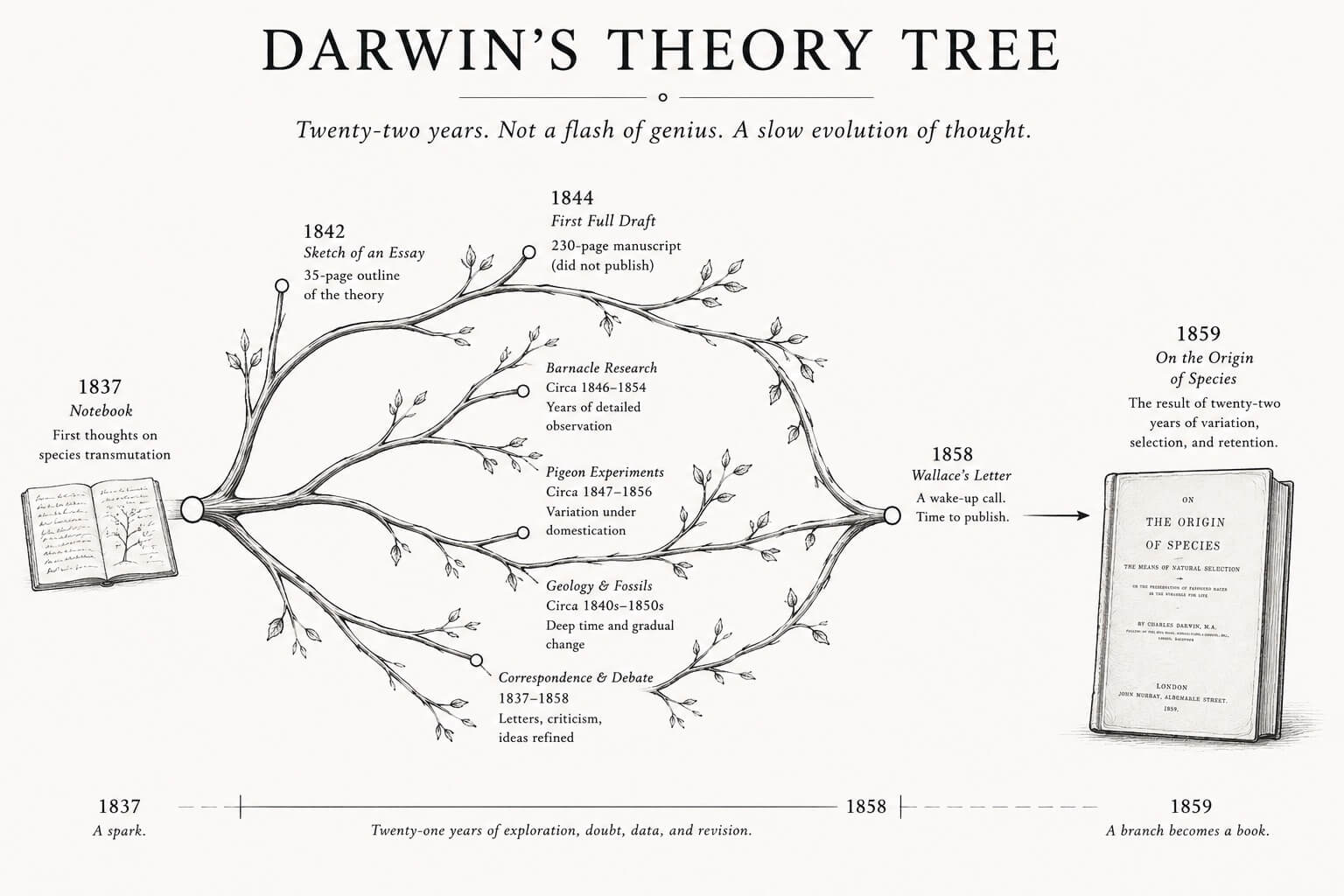
Darwin began sketching his thoughts on species variation in 1837. In 1842, he managed a rough 35-page outline. By 1844, he had expanded it into a 230-page essay, yet he chose to lock it away. What followed was a decade of intense, meticulous research into barnacles, geology, domestic breeding, and constant debate with colleagues. Every new piece of evidence acted as selection pressure—forcing his core theory to shed its weaknesses and retain its strengths.
Only when Wallace's letter arrived did Darwin finally focus on publication. In 1859—twenty-two years after his first late-night notes—On the Origin of Species was finally published.
If you look only at the published book, creation looks like an event.
If you look at those twenty-two years, creation looks like a forest.
5.2 Delay Is Not Blank Space; It Is Growth
From the outside, a twenty-year delay looks like procrastination.
From the inside, it was an idea constantly encountering new environments: geology, barnacle anatomy, pigeon breeding, island ecosystems, and fierce skepticism from trusted friends. Each new environment asked the exact same question: Is this argument strong enough? Where are the gaps?
Darwin didn't simply write a longer book. He allowed his core idea to face constant selective pressure, adapting and becoming sharper with every counter-argument it survived.
This is the true nature of creation.
The lesson of Darwin's twenty years is not that every project requires decades of silence. The lesson is that we must abandon the myth of the immaculate conception of ideas.
Great ideas are never born fully formed.
They require drafts, diversions, revisions, and structural selection. The real danger to a young idea isn't that it starts out imperfect—it is that it gets lost before its evolutionary history can be written.
We celebrate the book published in 1859 because it is a polished, beautiful fossil. But the actual creation happened in the messy spaces between those twenty-two years of drafts, false starts, and constant adjustments.
Epigram
A great work is never a single lightning bolt of genius; it is an evolutionary lineage that managed to survive until publication day.
This is the silent hurdle every creator must face:
It is not whether your initial idea is good.
It is whether your system can keep that idea alive long enough for it to become resilient enough to face the world.
Tonight's Action
Select an unfinished concept you are currently working on—the rougher, the better. Create a "Biography" page for it, and document just three things: its original, rawest form; one challenging counter-argument you haven't resolved yet; and how its core focus has shifted since you first thought of it. Do this to give your thought a visible history. Even Darwin's twenty years began with a single notebook entry.